fredag 4 september 2020

Rob Halford: A Great Poet


This is a post about a poet. 


Rob Halford is the singer and frontman of British band Judas Priest. 


Also, he has penned most of the band's lyrics. 


And some of these lyrics are more than mere "singable rock lyrics". They are poems in their own right. 


In this post I will try to prove this. This is a survey of the best Halford lyrical passages, from 1976 through 1988.   


We will primarily focus on the lyrical, ringing, sounding aspects of the words of Halford. However, we will also mention some wise Halford lyrics, poems teaching the listener Actionism.


- - - 


In the late 70s Priest rose to fame as a band, with words and music creating a new brand of fantasy rock. Focusing on the lyrics we can begin by looking at Stained Class (1978). On this album Halford’s lyrical ability is working overtime, especially in these lines of the title track:   


Wild-eyed and tight fisted, I'm fused to the bone 

I stand contemplating, reacting alone 

Impaled with betrayal 

The tourniquet turns 

Society's creation 

Pole-axed out and burnt 


From the same song we get this bridge with the words kind of crammed in, however, in a lyrical, ringing fashion: 


Lethal, deadly, hung, drawn and quartered 

He slaughtered and faltered and altered the world 

But by doing so smashed all his hopes and utopian dreams 

Whipping, stripping, peeling the flesh off, relentless and senseless 

His lust snapped like vipers whose fangs sank in deep 

To infest and decay from the core   


From the same album we have Exciter, depicting the progress of a Flaming Sword-type of guy. In my eyes poetical, in themselves ”musical” lines, are the following: 


Everything he touches 

Fries into a crisp, 

Let him get close to you 

So you're in his trip, 

First you'll smoke and smoulder 

Blister up and singe 

When ignition hits you the very soul of your being will cringe… 


In the chorus we then have the deathless words, ”Who is this man? … You'll never see him // But you will taste the fire upon your tongue”   


And more fiery poetry follows, like ”Predominant complacency // Leads to beguiling lies”… and the ending lines: 


When he leaps amidst us 

With combustive dance 

All shall bear the branding 

Of his thermal lance, 

Cauterizing masses 

Melting into one 

Only when there's order 

Will his job be done. 


- - -   


Next from Stained Class we have White Heat, Red Hot, a lot of quotable stuff in that one but we’ll limit ourselves to the first verse: 


The father's son, thy kingdom come, electric ecstasy

Deliver us from all the fuss and give us sanctuary 

Lead us all into arena, magnificent in death 

Well let us serenade the sinner, we'll follow in his step   


These are strong words, kind of Actionist in nature, along with the mere ring of the words.  


A final lyrical highlight from Stained Class is this passage from Invader: ”I came across a smoking field, pulsating afterglow // I saw a seering flash of light erupt and skyward go // I staggered back in dazed surprise / What was it I had seen? // And as I stood there mesmerized I heard my spirit scream”   


- - -   


In the same year as Stained Class (1978) we got the album Killing Machine. From the opening track (Delivering the Goods) we get these lines, the group describing its way of being: "Charging, vein faced, as active as one-hundred solid proof // Megaton, Leviathan, we're ready to hit the roof"   


Action as being, be strong, shine – that’s the Actionism of Judas Priest, visible here and in Take on the World from the same album: ”Sing your song, we'll listen to you. // Sing your song, the spotlights on you.”   


More Actionist poetry is given in the title song, Killing Machine: 


I never give true answers, I never tell no lies 

I never walk a straight line, so never get surprised

I don't ask no favors, so don't get abused 

I learned to win when I was young 

So I'm never ever gonna lose 


- - -   


So, where shall we go now? 


Backwards or forewards? 


We kind of began in the middle of the group’s career. And, now I feel like going backwards... which will lead us to 1977 and the album Sin After Sin.  


In the opening track we hear of “The Sinner” that “… roams the starways // Searching for the carcasses of war // But if it's hungry then its very presence // Disrupts the calm into the storm”… 


These are authoritative lines from a divinely inspired writer.


In Raw Deal we get this deathless impression of a drug-induced pandemonium: ”I'd had too much, floating around // Statues alive, seconds are hours”… We also get this immortal line, just right in the fragmentic collage of images: ”I guess I dream in pictures, not colors”…    


This is poetry and nothing else.   


- - -   


Halford was good at nonsense lyrics – meaningless and yet musical, like the opening line of Dissident Aggressor: ”Grand canyons of space and time universal”… 


We also mean that the mere title of this song (Dissident Aggressor) is poetical.   


Equally poetical is the very title of the previous album, Sad Wings of Destiny (1976), where Halford treats us to more lines in the area of surreal fantasy poetry. First, ”Skyrider, supersonic flyer // Nightdriver, demon of desire” (Island of Domination); and also, ”Solar winds are blowing // Neutron star controlling … Meteors fly around me // Comets die, and then they // And then they, you wanna see how they try to surround me” (Deceiver).   


Quotable as a more sober passage, still poetical, is this from Dreamer Deceiver:    


… in the cosmos is a single sonic sound 

That is vibrating constantly 

And if we could grip and hold on to the note 

We would see our minds were free... oh they're free   


For its part, this mirrors the Hindu idea of shabda, the primordial sound from which everything has been manifested.   


- - -   


Now let’s go forward in the catalogue. We’ve already covered 1978 so this will take us to British Steel of 1980.  


This album was a big hit and it’s got lyrics to match it. 


We get it all here; the nonsense (”From a fireball we came, ’cross sea and mountain // we were drinking beauty with our eyes,” The Rage); and the chauvinism (”Chopping away at the source soon the course will be done // Leaving a trail of destruction that's second to none,” Rapid Fire); and the supermanism (”Been inclined to wander // Off the beaten track // That's where there's thunder // And the wind shouts back,” Grinder); and the science fantasy (”fearing for our lives, reaped by robot scythes … meeting with our death, engulfed in molten breath”).   


The last quote was from Metal Gods -- and more on the divine side we got on the following album (Point of Entry, 1981). In Solar Angels Halford maybe had his lyrically finest moment, a hymn praising gods of light. Reportedly Halford is the son of a minister and you could say that it shows in lines like these:   


Golden halos radiating higher 

Diamond visions softly breathing fire 

Sky processions we are watching you arrive 


Silver crystals arching beams below 

What light spirals lifting up to go 

Glass formations solar angels spread their wings   


From the next album (Screaming for Vengeance, 1982) we’ll limit ourselves to quoting the final line of Electric Eye. Depicting the harsh reality of electronic surveillance the robotic eye itself takes the floor: ”Electric eye, in the sky, feel my stare, always there,” and then the authoritative ending: ”I'm elected, electric spy // I'm protected, electric eye // I'm elected, electric spy // I'm elected -- protective, detective, Electric Eye!”   


This is having a way with words. This is poetry – for, in themselves, even beyond the accompanying music, these lines sing.   


- - -  


Look before you leap has never been the way we keep 

Our road is free 

Charging to the top and never give in 

Never stops the way to be 

Hold on to the lead with all your will and concede 

You'll find there's life with victory on high…   


These powerful lines we find in the song Freewheel Burning on Defenders of the Faith (1984). Indeed, as the lyric intimates, victory is a must; an Actionist must always envision victory and not be dragged down by myopic everyday thought, by ”down-to-earth wisdom” saying that you can’t always win. Instead, you must always envison victory, laud victory, praise victory – like Halford is doing here and on a 1988 song, Hard as Iron: “And I’ll destroy, last thing you’ll hear me cry, is victory, is victory…!”    


In the just cited cases the poetry and the wisdom merges. The same is the case with Reckless from Turbo (1986), an Actionist paean if there ever was one: 


Around me I feel the shock waves, 

Building for the energy 

A force field no one can break through 

Solid as rock no wonder 

I am indestructible 

First placed in everything I do…


“First placed in every thing I do”: there we have it again, the unmitigated worship of victory!   


- - - 


Above we have given you some immortal Halford musical poetry. But he also writes prose poetry. Like this little blurb from Defenders of the Faith:  


"Rising from darkness where hell hath no mercy and the screams of vengeance echo on forever, only those who keep the faith shall escape the wrath of the Metallian..."  


This was signed, "Master of all Metal"... and I seem to trace the hand of Halford behind this.   


On the previous album, the one with the fearsome metal eagle on a yellow background, we had a similar sketch:  


"From a distant land came a winged warrior. Nothing remained hallowed, nothing remained sacred as it uttered its battle cry: Screaming for Vengenance." 


And the last three words was also the title of the album in question. All told, these little prose poems paint an unequalled aura of majesty and fantasy. Like the best of Rob Halford's rock lyrics. 


- - - 


With this we must lay down our pen. The brilliance of the Halford lyrics are stunning. Along with a strong, Actionist message we also, especially on the early albums, get a metal-sounding fantasy poetry with spiritual overtones, a crossing between Mayakovsky, William Blake and Samuel T. Coleridge.  


Related

Actionism -- How to Become a Responsible Man (2017)

The Flaming Sword

In Swedish: Översikt över Judas Priests historia


måndag 31 augusti 2020

Quinta Essentia


Behold, it’s a new day… -- Edit 2023: This text is now, mutatis mutandum, part of my essay Astral War, published by Manticore.


Quinta Essentia is the fifth element beyond earth, water, fire and air... it is also called vril.  


It is equal to Prima Materia = the elementary matter. In alchemical terms, it is the Prima Materia of the Magnum Opus.


“It is the body of the Holy Spirit, the universal Agent, the Serpent devouring his own tail” (Pike).


It is the Ether, nowadays formally denied by scientists, only called “gravity field,” “action-at-a-distance” and other fancy terms.


It is the Elixir of Life, the Fountain of Youth, the Philosopher’s Stone… 


It is “the Force” of Star Wars fame, an all-pervading power. As Yoda said: “My ally is the Force, and a powerful ally it is. Life creates it, makes it grow. Its energy surrounds us and binds us. ... You must feel the Force around you; here, between you, me, the tree, the rock, everywhere, yes."


- - -


The quintessence is this and more. 


It is the “white stone written with a new name” mentioned in Revelations. 


It is the Food of the Gods, manna, ambrosia, soma, Holy Water to my lips... the Golden Tear from the Eye of Horus. 


It is the Astral Light in Theosophic terminology.


It is dark energy, dark matter… and scalar energy, zero point energy. Nikola Tesla (1856-1943):"Electric energy is everyhere present in unlimited quantities and can drive the world's machinery without the need for coal, oil or gas". [Link to Swedish blog post.]


- - -


The Black Sun of Agartha is made of this quintessence. And the Holy Grail is an artefact made of Prima Materia. 


Also, corresponding to the human realm, Prima Materia and all its synonyms is equal to vital power, mental energy, Od, Ka, Vril… because, “wherever anything is, Vril is” (Tice, Vril or Vital Magnetism, 1911). 


Thus, you have it in you. In the form of Vril. Because, where anything is, Vril is.


So say to yourself: I have the power...!


Related

Odic Force

Painters and Draughtsmen

Biography of Svensson

Illustration: Robert Svensson

fredag 28 augusti 2020

"Nietzsche" -- A Poem by Stefan George


Today we give you a poem. By Stefan George.


Stefan George was a German poet who lived 1868-1933. He was a traditionally minded conservative writing free verse, kind of like Ezra Pound and T. S. Eliot.


A lot could be said about George. However, today we will just give you a sample of his poetic ability. It will be with the poem "Nietzsche," written in 1900, translated by me. It rather well captures the tragedy, the pathos, the elevation associated with this philosopher. Enjoy.


+++


Heavy yellow clouds scudding over the hills

and cool winds – half autumnal messengers, half early spring...

So these walls enclosed the Thunderer – he, the only

real one among thousands of smoke and dust around him.

From here to the flat lands and the dead cities

he sent the last quiet flashes

and went from a long night to the next night.


Stupidly the crowd wanders down below: do not scare it!

That would be like stabbing a jellyfish. No, cut off the weed!

For a while, still a pious silence

from the animals that stained him with praise

while fattening in the dark,

the ones who helped to strangle him.

But you, you stand radiantly ahead of the times

like other leaders with the bloody crown.


Redeemer you! while being the most unfortunate,

loaded with the force of an unnamable destiny.

Have you ever seen the smile of the promised land?

Did you create gods just to enthrone them,

never a quiet moment in a happy home?

You killed the neighbor in yourself

only to desire him anew and long for him,

crying out to him in the pain of loneliness.


He came too late, the one who said to you:

there is no way over icy rocks

and aeries of horrible birds – there is but one need:

to banish oneself from the circle of love...

And if the severe and tormented voice

then sounds like a praise in the blue night

and the bright flow – so lament: it would sing.

This newborn soul should not talk!


Related

How to Be a Nietzschean Superman

Burning Magnesium

Wagner and Popular Culture

torsdag 20 augusti 2020

Cars: Some Faustian Remarks


Hereby some lines about stuff. Automotive stuff.


In the video to Gary Numan’s Cars there are no cars. 

- - -

The car is a strong Faustian symbol. 

The car is a vital necessity to Western man. To Asians it’s not the same thing. Japanese and Chinese may build decent cars but they haven’t got it in their blood.


But we of the Faustian ilk live and die for our cars.


We have it in our blood. Can you otherwise explain why European cars are the strongest brands in the car world – still, after the 70s-and-on onslaught of oh-so efficiently built and decently priced Japanese cars...?


Japanese brands have a fair share of the market. But they can’t build top-of-the-line, crème-de-la-crème cars. They can have a shot at it (Lexus) but they can’t win (Mercedes).


The model premium car is European. And it always will be. Mercedes, BMW, Audi, Range Rover, Rolls Royce, Volvo, Citroën...


There is still some vitality in the Faustian culture. As we said in this post: the Faustian era won’t end just now, it’s got a thousand years more to shine in.


- - -


“If I can for six horses pay, their strength is mine – I dash away // a proper man, as if I’d known, all four-and-twenty legs my own.”


Thus we read in Faust, the Goethe play. This summarizes in nuce the Faustian spirit – the power, the glory, the sound, the fury, the speed, the movement; in short, the joy of driving a vehicle. Faust spoke about a horse carriage but the gist of driving a car is the same. 


Spengler knew what he was doing when naming our culture after this guy, Faust. With his striving to dominate nature, to know everything, to master all sciences, to go beyond the beyond, to go for the infinite, the vanishing point, in horse carriage or by any means, Faust is the symbol of our culture.


- - - 


Elon Musk built an electric car. Christian Koenigsegg built a supercar [link to Swedish post]. – The Faustian spirit is still alive; still men can dream about building cutting edge cars, still the vision can become reality. One man, one vision – then the willpower to effect it. I lift my hat to these guys. 


- - -


Cars and trucks etc. I’ve driven:


Mercedes Benz 200

Mercedes Sprinter

Saab 99

Saab 900

Opel Ascona

Renault 5

Renault Megane

Renault Trafic

Volvo 240

Volvo V40 Cross Country

Volvo F611

Volvo F407

Bandvagn 206


- - -


I’ve just been told that Russell Kirk regarded cars as “mechanical Jacobins,” that is, as modernizing forces separating us from tradition. – I’ve no sympathy at all for this attitude. It reeks of the complete abstention from modernity otherwise displayed by men like Frithiof Schuon and C. S. Lewis. 


The car is here to stay and it’s central for everything Faustian; it’s an undying symbol, it’s a necessity. It’s like riding a horse. Was the invention of horseback riding a mistake too? Would solely resorting to your walking feet lead us back to paradise? 


This I ask the likes of Mr Kirk.


The riding of a horse, the riding of a car creates a certain mindset. And this isn’t just Faustian, it’s human. Like horseback riding being invented already in the previous era, around 700 BCE, at the dawn of the Greco-Roman era. And it spread all over the Old World, not just over the West.


- - -


I once had a dream, a dream of a song. It went: “If you’ve got a car, got a trailer or a jeep”...


That was the line. I even heard a melody.


I wanted to make a complete poem of it. So, after some labor while awake I came up with this, a little ditty about cars, about a guy saying that he will gladly drive any of the cars his lady might have:


If you’ve got a car, got a trailer or a jeep,

Mercury Cougar, make sure it ain’t cheap.

Chevy Corvette, Metropolitan Met,

a Dodge or a Fudge – 

then baby I can drive your car... 


Related          

Faustian Era

Good Reads September 2019

Wagner and Popular Culture

In Swedish: Koenigsegg

Pic: Me next to a Renault 5, 1989

måndag 17 augusti 2020

The Actionist

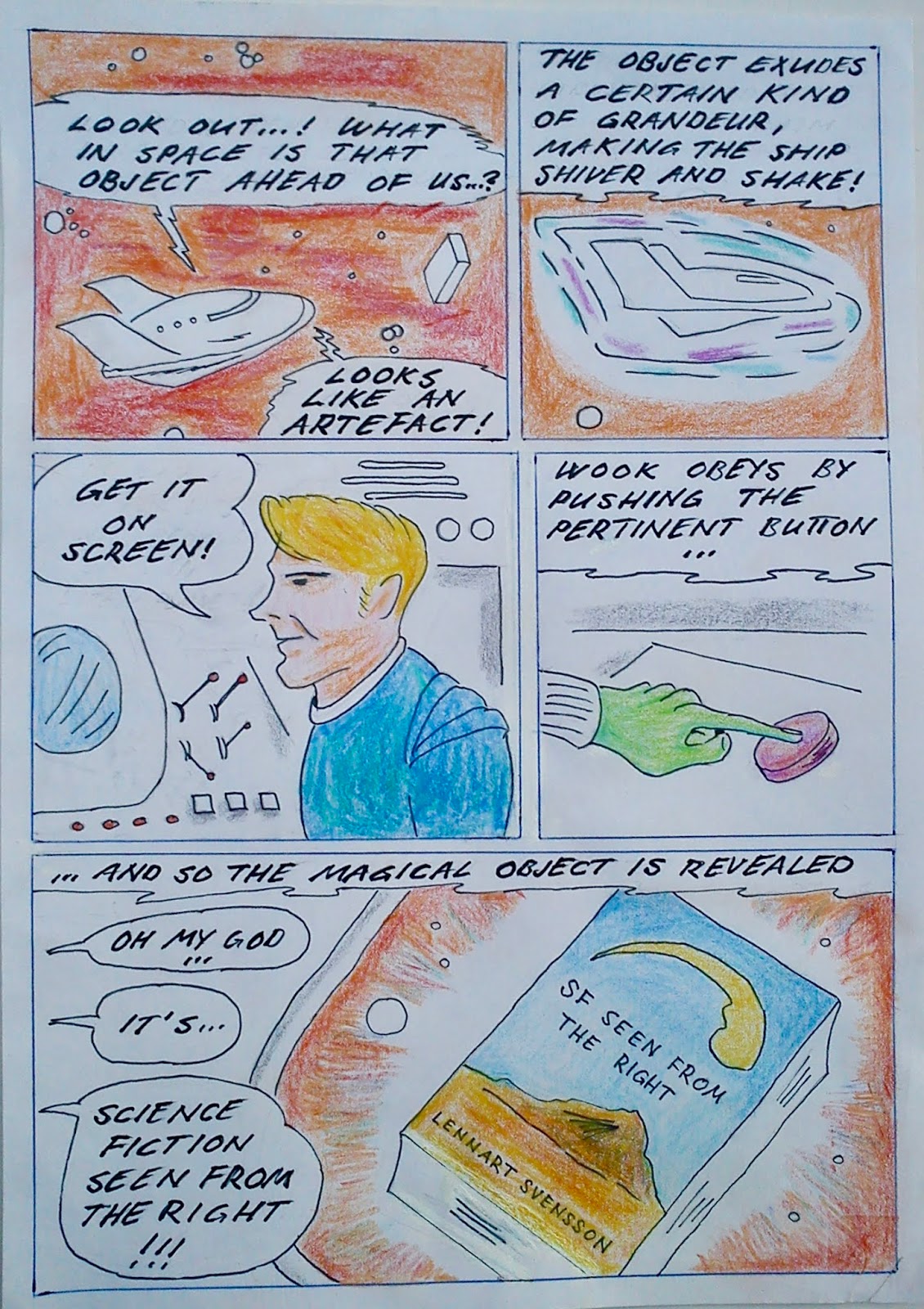
 Hereby a post. In the form of a comic series. Motive? Promotion. It's about promoting a book. This book. 


More info about the book


Buy the book on Amazon


Buy the book on Adlibris


Related

Astral War

Christina Lindberg

The Flaming Sword (short story)


onsdag 5 augusti 2020

How to Be a Nietzschean Superman

Today we give you a course in Supermanism. -- Edit 2023: the text below is now, more or less, included in my essay Astral War (Manticore Press 2023).


How to be superman? It’s easy; just will it.


Nietzsche coined the very term “superman”. In Thus Spake Zarathustra he says that man is something to be overcome; man shall strive to be more than he is. He shall elevate himself into virtual godhead and become a dancing Dionysos, a man possessed by Odin.


Nietzsche intimated the presence of Odin in the poem “To the Unknown God” from 1863-64. And the spiritual side of his Zarathustra book I covered in Borderline.


In a letter to a friend (Meta von Salis) Nietzsche wrote: “Fraulein von Salis. The world is transfigured, for God is on the earth. Do not you see how all the heavens rejoice?”


This he wrote shortly before going mad but these lines aren’t mad as such. If a god walks the earth it would indeed be transfigured and the heavens would rejoice. Nietzsche’s letter nails the state of “god incarnated as a man”. The madness can also be seen as “divine madness”. 


- - -


To be a superman in Nietzsche’s conception wasn’t only about divine elevation, Dionysian dance and all that jazz. It could also mean human perfection. He meant that figures like Goethe, Montaigne, Voltaire and Napoleon were good examples of this kind of perfection. They fulfilled the dictum, “be all that you can be”.


So, you superman aspirants out there, to be superman isn’t so very hard. Just perfect your talents and shine.


- - -


Above we saw how Nietzsche mentioned “transfiguration,” and now some more of it... 


In The Will to Power Nietzsche says this which is divine supermanism in nuce: “[M]an becomes the transfigurer of existence when he learns to transfigure himself.” (The Will to Power, p. 434)


From the same book, very apt, very holistic: “If we affirm one single moment, we thus affirm not only ourselves but all existence. For nothing is self-sufficient, neither in us ourselves nor in things; and if our soul has trembled with happiness and sounded like a harp string just once, all eternity was needed to produce this one event—and in this single moment of affirmation all eternity was called good, redeemed, justified, and affirmed.” (ibid,p. 532–533)


- - -


Two more quotes from Will to Power... about being strong.


1. “I teach the No to all that makes weak—that exhausts. I teach the Yes to all that strengthens, that stores up strength, that justifies the feeling of strength.”  (p. 33)


2. “It is only a question of strength: to have all the morbid traits of the century, but to balance them through a superabundant, recuperative strength. The strong man.” (p. 524)


- - -


Thus Spake Zarathustra shows us the superman brimming of energy. The last lines of the book should suffice to illustrate the power exuding from it in its best parts, the aura of vital energy virtually dripping off the page:


"Do I then strive after happiness? I strive after my work!... This is my morning, my day beginneth: arise now, arise, thou great noontide!” – Thus spake Zarathustra and left his cave, glowing and strong, like a morning sun coming out of gloomy mountains." [p. 368, Thomas Common translation]


- - -


As I said in the beginning: be superman, it’s easy... you just will it.


Related

Borderline

Jack Steelnack

Illustration: Robert Svensson

Svensson: Spera in Deo (poem)


Hereby a poem by Lennart Svensson. The author of Actionism.


On the tower of Åsele church
is inscribed: Spera in Deo.

On the Apollo temple of Delphi
is inscribed: Gnôthi Seautón.

And on my heart is inscribed:
Aham brahmâsmi.

Believe in God.
Know Thyself.
Illustration: Robert Svensson

måndag 27 juli 2020

måndag 20 juli 2020

Interesting Facts


Hereby some unusual facts. From history etc.


Cars

. To accomodate the torsion bar suspension the Renault 16 has a shorter wheelbase on the right side.

. The oldest car model still in production is the Chevrolet Suburban, debuting in 1935.


Aircraft

. "The Spruce Goose," Howard Hughes's giant aircraft, was mainly made out of laminated wood, mostly birch (not spruce).

. The right wing of Macchi C.202 Folgore is shorter than the left wing. The left wing has a larger surface, having more lift, in order to counteract the torque of the engine.


Geography

. In Colombia there’s a town called Turbo.


History

. The 1933 Reichskonkordat between Germany and The Holy See is still valid.

. In 1762 French philosopher Rousseau said of Corsica: “I have a premonition that some day this little island will astonish Europe.” Seven years later Napoleon was born there.

. Richard Lionheart is known as an English king. But he only spoke French.

. When king Alfred of Wessex visited Rome he was given the title of “Roman Consul,” 400 years after the fall of the Roman Empire. -- Speaking of the longevity of Roman titles: whether he’s historical or not, Rome’s founder Romulus adopted the title of Pontifex Maximus, "great builder of bridges". Today, almost 3000 years later, the Pope of Rome carries the same title.

. “What price, Churchill?” – In 1939, after Churchill once again had failed in his efforts to enter the government, posters with this text was seen in central London. It’s still not known who was responsible for the posters.

. The medals for the Victoria Cross is still made by bronze from cannons, taken at Sevastopol during the Crimean War.

. When the Duke of Wellington (the victor of Waterloo) was buried, it took over an hour to read out all his titles.

. WWII, unusual enemies: in 1940, the Brits sinking French ships at Mers-el-Kebir. And Brits fighting the French in the Syria-Lebanon campaign of 1941.

. WWII, unusual allies: after the Japanese surrender in 1945, the Brits were using surrendered Japanese as auxiliary units in fighting Indonesian guerilla.

. The German WWII general Hasso von Manteuffel was only 142 cm tall.


Related
Jack Steelnack: An Interview
Lindberg Business
"Burning Magnesium" (2018)

söndag 12 juli 2020

Actionism i Nya Tider


Tidigare i år kom nummer 6 av Nya Tider. I den presenterades Actionism. Min livsfilosofi. Se här.


Jag skrev artikeln. Som synes. Dock ges i länken bara inledningen.

Artikeln handlar om hur Actionism är baserat på vilja. Och tanke. Och att allt börjar med dig.

Läs mer här.

Boken presenteras även på bloggen i detta inlägg.

- - -

I maj 1950 presenterade L. Ron Hubbard sin filosofi Dianetik i tidningen Astounding. Och i februari 2020 presenterade alltså jag min lära i Nya Tider.

Utan jämförelser i övrigt är det hela alltså frågan om historiska event i filosofins historia.


Relaterat
Actionism i Nya Tider
Boken presenterad på bloggen
Christina Lindberg

onsdag 8 juli 2020

Antropolis säljes


In Swedish. -- Min roman Antropolis från 2008 finns att köpa. Av mig.


Nu finns min roman "Antropolis" åter att köpa. Priset är 300:- inklusive frakt.

Maila mig på lennart.svensson24@comhem.se för betalningsinfo (både Paypal och Swish finns).

- - -

"Antropolis" skildrar en maktkamp i en stad i framtiden. Jenro Klao har byggt upp Antropolis från ruinerna. Men allt är inte frid och fröjd. Staden slits itu av idéer om teknokrati kontra andlighet. Ska Jenro Klao lyckas ena fraktionerna, ska Antropolis kunna leva som en kultur byggd på konst, vetenskap och kristallteknik?

"Antropolis" har gillats av sina läsare. I maj 2014 skrev till exempel Joakim Andersen detta om boken på Motpol:
Sammantaget är det alltså en fascinerande och läsvärd roman, en kombination av idéroman och framtidsvision. (...) Författarens bildning lyser igenom i romanen, och bidrar till upplevelsen. Den centrala roll mat, dryck och rökning spelar är gissningsvis också kopplat till författarens personlighet, liksom den betydelse det musiska har. Så är det ingen slump att Antropolis grundas efter att Klao börjar spela på en gammal orgel i kyrkoruinen. de Maistre menade att varhelst man finner ett altare, där finns civilisation, men där det finns en orgel finns förmodligen också Antropolis. -- Antropolis rekommenderas i varje fall varmt, det är en läsupplevelse på flera plan och en unik sådan.
Och i mars 2014 skrev Thomas Nydahl detta om "Antropolis" på sin blogg:
I Lennart Svenssons roman glider verkligheten och drömmarna in i varandra, utopierna och idealen blir ett med den skröpligaste tillvaro. Känslan av att inte stå på fast mark håller kvar mig i läsningen. Jag tycker mycket om detta, kanske mest av allt för att det är något för mig helt nytt och främmande. Ett spår i läsningen som jag aldrig tidigare befunnit mig i. Så det är klart att jag rekommenderar Antropolis!
Men inte nog med det, för i november 2011 skrev Peter Öberg detta om "Antropolis" på bloggen Spektakulärt (bloggen tycks numera vara raderad):
I boktitelns stad befinner sej den filosoferande Jenro Klao, stadens grundare, eller återupptäckare om man så vill. Han blir vittne först till stadens förvandling till "städernas stad", sen till kampen mellan teknik och ande representerade av två fraktioner i staden. (...) Språket är skönt, präglat av ett behagligt om än kanske för jämnt tempo, och fyllt med allehanda funderingar samt referenser och fina ord som undertecknad inte är bekant med men som vittnar om författarens bildning.
Boken är i hårdpärm med skyddsomslag. Se bilderna nedan för den fiffiga layouten och det läckra, gröna klotbandet. Sidantal 205. ISBN-nr 978-91-633-3887-8.

Vill du ha en roman som sammanfattar människans ödesfrågor idag, köp och läs "Antropolis". Sedan romanen skrevs 2009 har den bara blivit mer aktuell. Det handlar om idealism kontra nihilism, kultur kontra titanism.


Relaterat
Mer info om romanen
Antropolitansk profil 1: Hadar Lacq
Antropolitansk profil 2: Elander Lysion
Antropolitansk profil 3: Gotsis Fripp